Tags: combinatorics
1 projective plane
some results from https://www.homepages.ucl.ac.uk/~ucahbdo/FiniteProjectivePlanes.pdfDefinition 2.1. A Projective plane P is an ordered pair of sets (p(P), l(P)), whose elements are called points and lines, respectively, and a relation between these sets, called incidence, satisfying the following axioms:points are vertices and lines are hypergraph edges. The axioms are saying
- Given any two distinct points, there is exactly one line incident with both of them.
- Given any two distinct lines, there is exactly one point incident with both of them.
- There are four points such that no line is incident with more than two of them. We say that a projective plane is finite if the number of points of the plane is finite.
- for any two vertives there is exactly one edge contain them.
- for any two edges their intersection is one vertex.
- you can find 4 vertices in the hypergraph that no edge contains more than 2 of them.
∎
by duality similar theorem holds for lines.
suppose the number of lines incident with every point is
,
then define the order of the projective plane to be
.
One can see that the number of lines and points on a projective plane
are the same. Suppose the order of the projective plane is
and there will be
lines incident with each point and on each line there will be
points. Thus the number of lines is
,
the same as points.
Theorem 2.5. means the corresponding hypergraph must be
-uniform
and
-regular
For special(satisfying the above 3 conditions)
-uniform
-regular
hypergraph we easily know the number of edges and vertices is
,
so order
projective plane has exactly
points and lines.
However not all order is possible. All known order of projective plane
is prime power. The existence of finite projective planes of other
orders is an open question. see https://en.wikipedia.org/wiki/Projective_plane#Finite_projective_planes
2 Mutually orthogonal Latin squares(MOLS)
Latin square is just sudoku without the property of no repeated values in any of the nine blocks. Latin squares can be of size not just . https://en.wikipedia.org/wiki/Mutually_orthogonal_Latin_squares There is a thick book about this topic. Latin Squares and their application see chapter 5.2 for details about MOLS and projective planes. from now on we only consider Latin squares of the same size. Given two Latin squares and , make a new square (called Graeco-Latin square or Euler square or pair of orthogonal Latin squares). is an ordered pair of and . If there are no two cells in contains the same ordered pair, then the two latin squares are called orthogonal. A set of Latin squares are orthogonal if and only if they are pairwise orthogonal. Denote a set of mutually orthogonal Latin squares by . I am insterested in . One can see that since … well i don’t know how to prove this. I find a proof from Latin Squares and their application.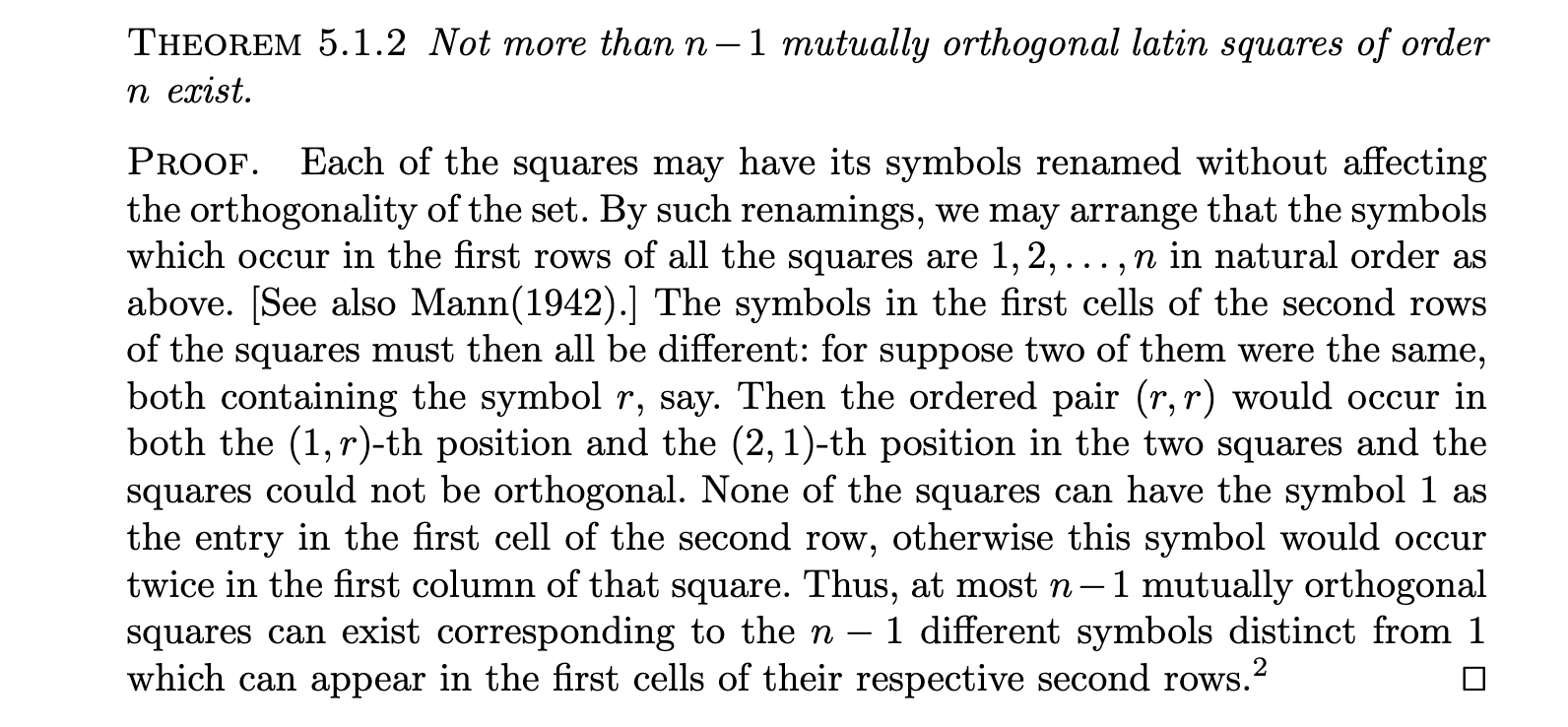
2.1 How is MOLS related to projective planes?
The question, for which is still open. Theorem 5.2.2 Every finite projective plane of order n defines at least one complete set of MOLS of order n; and conversely a complete set of MOLS of order n defines a finite projective plane proof:- projective plane => MOLS. Consider an order projective plane and choose one line . There will be lines on , say they are . For any point there will be lines incident with it. Denote lines(other than ) incident with by . Denote these lines incident with (or ) by . Note that for any two points on the projective plane there will be exactly one line incident with both of them. Consider one of the points other than . There will lines incident with and there are points on . Thus can be identified with the ordered tuple of lines incident with both some and . We write in the th place of the th Latin square. One can easily verify that this construction guarantees a MOLS of size .
- MOLS => projective plane. Juse the inverse of the previous construction. Not hard to see the resulting structure is an order projective plane.
∎
3 truncated projective plane
Truncated projective plane is just a projective plane removing one point and all lines incident with that point. The interesting property is that if considered as hypergraphs truncated projective plane of order is an -partite hypergraph and each line intersects with every other lines. proof: The -partites are exactly those sets of vertices on the deleted edges. They are disjoint since otherwise there will be two edges contains two common vertices. One can see that if one edge contains two vertices in the same part, this edge should be exactly the edge contains all vertices in this part and thus it should have been deleted. So no edge contains more than 1 vertex in one part. The min vertex cover is since all vertices in one partite are needed. The fractional matching(hitting set) = fractional vertex cover(edge packing) = if we assign to every hyperedge. (note: they are dual) So for truncated projective planes the packing-cogirth gap is really large.4 Ryser’s conjecture
For hitting sets and edge packing in hypergraphs, one can see thatmax edge packing() <= max fractional edge packing() = min fractional hitting set() <= min hitting set() moreover for -uniform hypergraphs, it is easy to see that . Ryser’s conjecture says for -uniform -parite hypergraphs . It has not been proven yet. There is another Ryser-Brualdi-Stein conjecture about size of transversals in Latin squares. recent work on arxiv https://arxiv.org/pdf/2310.19779.pdf Matroid bases can be considered as edges of uniform hypergraphs. For which kind of matroid the corresponding hypergraph has a small upperbound for ?