In the previous post, we mainly focus
on the algorithmic part of integral and fractional base packing and base
covering. In this post we consider packing and covering of matroid
circuits.
Theorem1
Let
be a matroid without coloop. Then one has
where
is the minimum number of circuits whose union is
,
is the number of connected components in
,
is the corank and
is the max number of disjoint circuits.
The left hand side
is called the circuit covering defect and the right hand side
is called the circuit packing defect. I guess the name
“covering defect” comes from the fact that
is the gap between the circuit covering number and a lowerbound
.
since there is no circuit containing two elements in different
components. The packing defect is the set-point dual of the covering
version. To see the duality, one can write
as the max size of
such that
for all circuit
and write
as the minimum size of
such that
for all circuit
.
2 Complexity
Computing the corank
and the component number
is easy. What about
and
?
The problem of determining if a sparse split graph (a special case of
chordal graphs) can have its edges partitioned into edge-disjoint
triangles is NP-complete [2]. So finding
and
is NP-hard even for some special graphic matroids.
3 Cycle Double Cover
Cycle double
cover conjecture is a famous unsolved problem posed by W. T. Tutte,
Itai and Rodeh, George Szekeres and Paul Seymour. The cycle double cover
conjecture asks whether every bridgeless undirected graph has a
collection of cycles such that each edge of the graph is contained in
exactly two of the cycles.
[3] is a nice
survey. However, there is little discussion about (even simplier version
of) circuit double cover on some special case of matroids. For example,
this
question on math.sx is a relaxation of faithful CDC on matroids.
Problem2Not so faithful circuit
cover
Given a matroid
and a non-negative integral weight function
,
decide if there is a multiset of circuits of
such that each element in
is covered by at least 1 and at most
circuits in the multiset.
[4] studied
a related (and seemingly simplier) optimization variant. How many
circuits can we pack with element capacity
?
Clearly the linear relaxation of
and of
are LP dual of each other and have the same optimum. For what class of
matroids do we have equality
for any weight function
?
When
this is relatively simple. First we can assume that
contains no coloop since coloops won’t appear in any circuit. Suppose
that there are two circuits
whose intersection is non-empty. Let
be the smallest weight of elements in
respectively. It follows by definition that
and
.
The max number of circuits we can pack in the matroid
is
.
Now we further assume that
.
The minimum weight of elements hitting every circuit is not necessarily
,
since by the circuit axiom there must another circuit
for any
which won’t be hit if we are selecting element in
.
Thus for the case of
,
any matroid satisfying
has no intersecting circuits.
The characterization of matroids satisfying
is the following theorem [4].
Theorem3
A matroid satisfies
iff none of its minor is isomorphic to
or
,
where
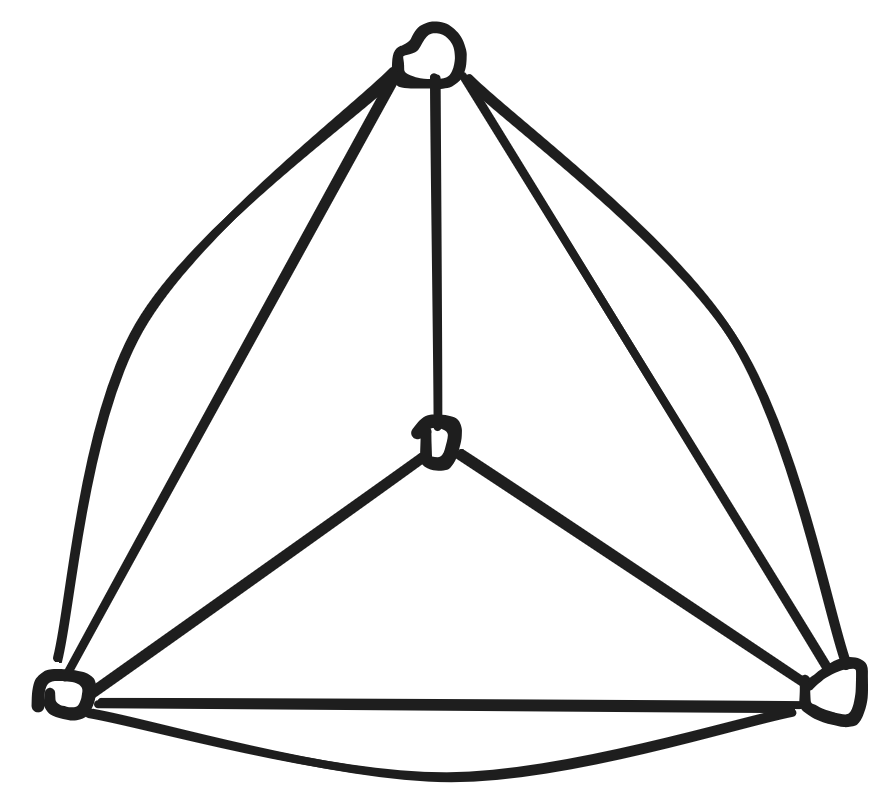
is
deleting an edge and
is a special 4-node graph.
Graph K
Their proof is also based on LP. In fact they prove the following
theorem.
Theorem4
Let
be a matroid. The following statements are equivalent:
does not contain
or
as a minor;
the linear system
is TDI;
the polytope
is integral.
is easy. To show
they prove that if
satisfies 3 then so do its minors and none of the matroids in 1
satisfies 3. The hard part is proving
,
for which they use the following two lemmas.
Lemma5
If
satisfies 1, then
for some graph
that contains neither the planar dual of
nor of
as a minor.
Proof
A matroid
is regular iff it has no minor isomorphic to
.
Then
must be regular since it satisfies 1. The lemma then follows from the
“excluded minor characterization of graphic matroids in regular
matroids”. A regular matroid is cographic iff it has no minor isomorphic
to
and
.
(see Corollary 10.4.3 in Oxley’s Matroid Theory book 2nd edition)
Lemma6
If a graph
contains neither the planar dual of
nor of
as a minor, then
satisfies 2.
This is the hardest part and it takes a lot of work to prove it.
They first prove a complete characterization of grpahs that contain
neither the planar dual of
nor that of
as a minor using
-sum
and then prove that summing operations preserves the TDI property.
The
-sum
theorem looks like this. Let
and
be the planar dual of graph
and
respectively.
Theorem7informal, thm 3.1 in [4]
A simple graph
has no minors
and
iff
can be obtained by repeatedly taking
-sums
starting from some small graphs and from some cyclically 3-connected
graphs with no minors
and
.
It remains to show that all the summand graphs in the above theorem have
the TDI property.
some notes on TDI (cf. section 22.7 in [5])
Let
be a rational matrix and
be an integral vector. For any rational
we have the following inequalities:
If we have equality on the last two
for all integral
,
then then all five optima are equal for each integral vector
.
It suffices to require that the last two optimum are equal for each
integral
.
Theorem8
The rational system
is TDI, iff
is finite and is attained by integral
for each integral
such that
is finite.
This is exactly the case of
in the characterization of matroids with
.
The above theorem on TDI reduces proving that
is TDI to proving that
has an integral optimal solution for all nonnegative integral
Recall that it remains to prove that some cographic matroids have the
above property. The set of circuits corresponds to cuts in graphs. A
graph is good if its cographic matroid satisfies that
has an integral optimal solution. They further characterizes good graphs
using cuts.
Let
be a collection(multiset) of cuts in
.
is truncatable if there is another collection
of cuts in
,
such that
,
Let
for a collection
be the number of elements in
containing
.
for all
A graph
is truncatable if every collection of its cuts is truncatable. They
shows that a graph is good if and only if it is truncatable. Then this
becomes a graph theory problem. They provides some sufficient condition
for graphs to be truncatable and manage to prove all the graphs we are
interested in are good. (a 16-page long proof)
Ding and Zang’s work [4] characterizes matroids that satisfy
.
As noted before and in their paper, matroids that satisfy
must be direct sums of circuits (if there is no coloop). The
result can be understood as finding matroids whose integral circuit
packing number and integral circuit hitting set number are equal. One
may wonder if people have studied similar things on matroid bases. There
are lots of works (see refs in this paper) on homogeneous
matroids which have the property that fractional base packing number
(strength) equals to fractional base covering number (fractional
arboricity or density). However, the analogous question for bases should
be characterizing matroids with
Is this problem interesting or is there any existing paper?
Updated on Aug 14th. Yes, there is existing paper
characterizing matroids with
Let
be a matroid with
.
We call
-reducible
if
.
Otherwise
is
-irreducible.
Let
be the set of minimum cocircuits of
.
Then the crux of
,
denoted
,
is defined to be
Let
be the number of connected components of
.
Assume that
has
connected components
.
For each minimum cocircuit
of
,
let
denote the largest subset of
such that the restriction of
to
is connected. Then the assembly hypergraph of
, denoted
,
is the non-uniform hypergraph whose vertices are labelled by the
connected components
,
where the hyperedges are labelled by the cocircuits
,
and the vertices incident with
are precisely the members of
.
Theorem9Theorem 21 in [6]
Suppose that
is a matroid for which
.
Then we have the following.
There exists a unique set of k-irreducible matroids
(for some integer
).
There exists a unique rooted tree
with
leaves labelled by
,
such that the root is labelled by
and each non-leaf labelled by
has
children, labelled by the connected components of
.
For each non-leaf, labelled by
and its
children labelled
,
there exists a unique assembly hypergraph with
hyperedges, and where
.
References
[1]
P.D. Seymour, Packing and covering with matroid
circuits, Journal of Combinatorial Theory, Series B. 28 (1980)
237–242 10.1016/0095-8956(80)90067-2.
 Graph K