Problem1
Given a graph
and an integer
,
find the minimum edge set whose removal breaks
-vertex
connectivity?
Alternatively, one can consider a closely related version of Problem 1,
Problem2
Given a graph
and an integer
,
find an edge set
with size at most
whose removal minimizes the vertex connectivity of
.
This problem can be called the “vertex connectivity interdiction”. One
can also consider the “algebraic connectivity interdiction” (the second
smallest eigen value of the Laplacian matrix).
In fact, I think Problem 2 is not well motivated. I am interested in it since there may be connections between breaking vertex connectivity and breaking combinatorial rigidity. However, it seems strange to consider interdiction problems on edge set for vertex connectivity. For vertex removal, this problem is easy (by splitting vertex and finding mincut).
1 Checking -vertex connectivity
Checking if a given graph is -vertex connected can be done in polynomial time. By Menger’s theorem we need to check if for every vertex pair there are at least vertex disjoint paths (excluding and ) connecting and . The number of vertex disjoint paths between and can be easily computed through max flow. We replace every internal vertex with two copies and and add directed edges from to and from to with capacity 1. The integral max flow is the number of internally disjoint paths between and . Since the constraint matrix of flow problems is TU, maximizing the flow gives us the vertex connectivity.Instead of computing the flow for every pair, if we want one flow that gets the demand for every vertex pair , the problem becomes much harder. This is Multi-commodity flow problem.Currently the fastest algorithm for computing vertex connectivity is
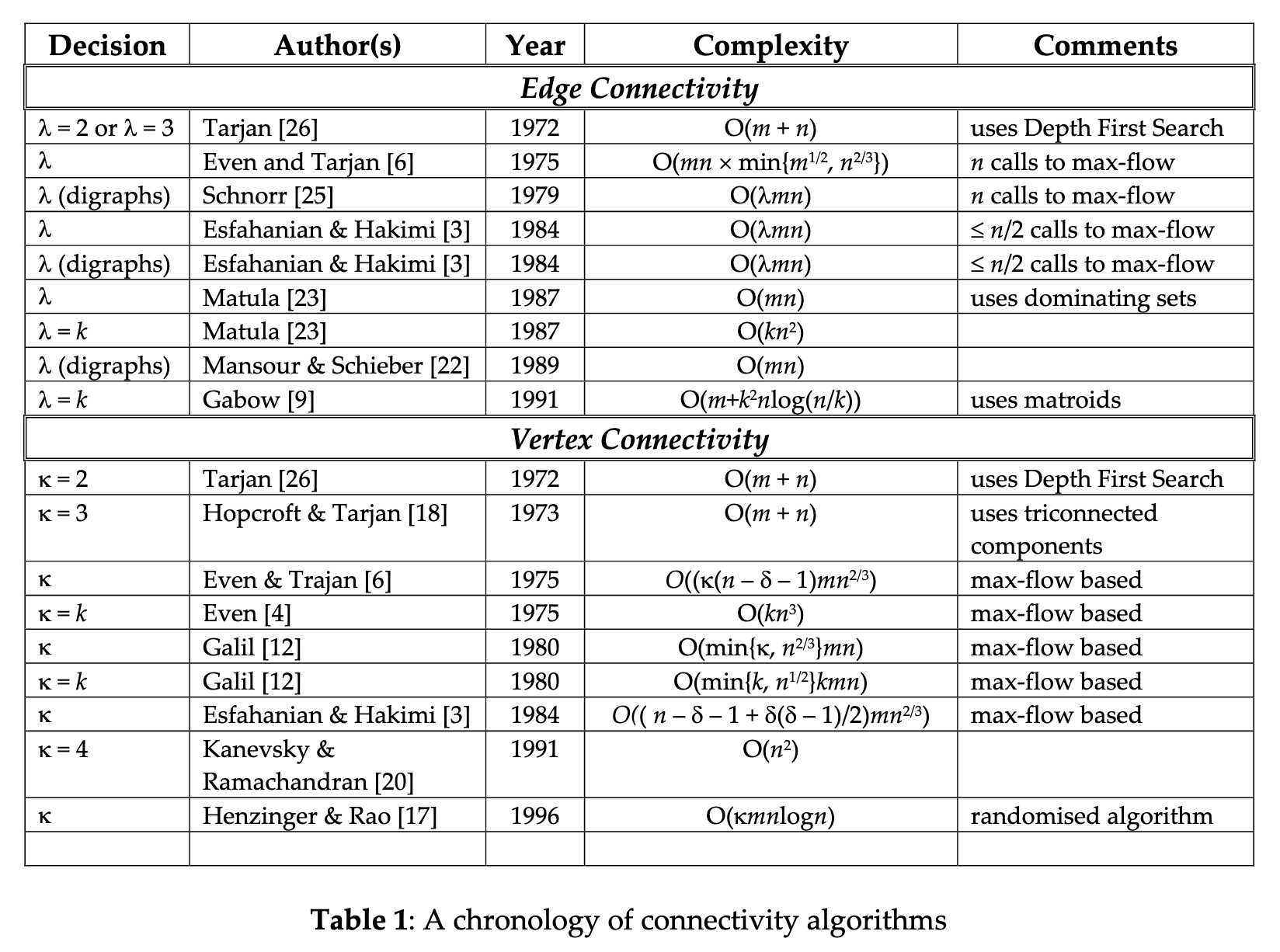
1.1 Minimum cut for edge connectivity
Finding the minimum edge set whose removal breaks the -edge connectivity is “easy”. It is known that the global min-cut is the edge connectivity number.1.2 Minimum cut for vertex connectivity
With the knowledge of how to compute vertex connectivity, we try to compute the minimum cut for -vertex connectivity in a similar way. First we can find the vertex pair with the smallest number of internally disjoint paths. Note that we are dealing with the modified graph when computing the vertex connectivity number with flow. Hence the min-cut may contain edges that are not in the original graph, i.e., the edges connecting and . For example, consider a graph where every edge has multiplicities 2. The min-cut reported by the flow algorithm should only contain edges between and . There is a list of open problems on vertex(node) connectivity. I guess Problem 1 is NP-hard but cannot prove it. However, the capacitated version of Problem 2 and Problem 1 is hard. Given a graph and edge weights and costs and a budget , find edge set such that and such that removing minimizes the vertex connectivity of . Similar to the edge connectivity case (which will be shown in the next section), if the cost is nontrivial then kanpsack is a special case of this problem. (Consider for some large . Pick a in and set the cost of edges in to infinity.) How hard is Problem 2 if costs are trivial?2 (Edge) Connectivity interdiction
If we replace the vertex connectivity in Problem 2 with edge connectivity, then the problem is called connectivity interdiction and was first studied by Zenklusen [2].
Problem3
Given a graph
and costs
and weights
and a budget
,
find the edge set
such that
and that minimizes the
-weighted
min cut in
.
The Fault-Tolerant Path
problem (FTP) seems sililar to Problem 3. In FTP problem, we are given a
edge-weighted directed graph
,
a subset
of vulnerable edges, two vertices
and integers
and
.
The task is to decide whether there exists a subgraph
of
with total cost at most
such that, after the removal of any
vulnerable edges,
still contains an
--path.
The problem degenerates into finding
-edge
connected spanning subgraph if the set of vulnerable edges is
.
A recent paper [3] gives an
FPTAS for the problem. Here I try to develop the intuition since I have
never seen an algorithm based on reweighting edges this complicated and
ingenious.
First one can see that the optimal solution can always be a subset of
edges in a cut of
.
This is because if the optimal solution
contains any edge not in the cut, we can safely delete it from
.
Thus the optimal solution is indeed a pair
.
The authors call this problem the
-free
min-cut problem
(
is the budget and we are allowed to pick edges for free in the “mincut”
with total weight at most
).
So the goal is to find a FPTAS for the
-free
mincut problem. The problem is hard since it contains knapsack as a
special case. (Consider a graph with many parallel edges and only 2
vertices.) However, it is known that there is a FPTAS
for knapsack. If we know part of the optimal solution, i.e.,
,
we can use the FPTAS for knapsack to find the optimal
.
At this stage, if there is a hint suggesting reweighting the edges, I
would guess that
is exactly (or close to) the min-cut of the re-weighted graph. Based on
this idea I would also guess that, although the connectivity
interdiction problem
(-free
min-cut) is NP-hard,
can be computed in polynomial time. In other words, the intractable part
is solving the knapsack in
.
This statement seems reasonable, since this problem is know to be in P
for unit costs and in that case the kanpsack is trivial. Let’s assume
that my guess is correct and work on the reweighting part.
2.1 Reweighting
There is a chapter on reweighting in Sariel Har-Peled’s gemetric approximation book(not quite the same as the reweighting technique in [3]). Is reweighting a common technique for designing approximation algorithms? One possible weight function is setting for all … However, this is cheating since we assume that is the hard part. So now we need to find a weight function such that the following holds,- The min-cut of the re-weighted graph is close to .
- Computing the weight function takes polynomial time.
Problem4Normalized
min-cut
Given a problem instance of connectivity interdiction, find a cut
and its subset
s.t.
and
is minimized.
2.2 More on normalized min-cut
If one slightly modifies lemmas in section 2 in [3], there are some interesting properties. Let be the value of the optimal normalized min-cut (in [3] is an estimation of the optimum) and define accordingly. Then one can prove that the global min cut in is exactly the optimal cut in the normalized min-cut of (slightly modify lemma3 to see this). Also the value of min-cut in is . For unit cost, the optimum of normalized min-cut can be computed using the same complexity as connectivity interdiction (ignoring polylog factors) [4]. Consider the sequence . If this is unimodal, calls of connectivity interdiction algorithm should be sufficient. (Note that is at most since costs are unit.) However, one can easily see that this sequence is not unimodal. Thus I don’t quite believe this claim.Comments on [3]
After reading [4], I finally know why the authors use Problem 4 to solve connectivity interdiction. Almost all techniques they used are directly from [4]. Read section 2 of [4] until 2.2, you know almost everything needed for a FPTAS solving connectivity interdiction. In fact, the authors cite [4] in their paper,In a recent paper of Chalermsook et el. [CHN+22] on survivable network design, the same problem was first introduced (under a different name “minimum normalized free cut”) to deal with a certain boxing constraint in the LPs. There, a special case of unit-edge costs is actually solved as a technical necessity. To obtain an FPTAS in this paper, we emphasize that we do not need to solve the normalized min-cut problem per se, but rather we use its optimal solution as a certificate in the analysis of the weight function in Theorem 3.This paragraph is somewhat misleading. There is no clearly indication that very similar (in fact, almost identical) results are proven [CHN+22]. It was mentioned in a footnote of [4] that a general version of normalized min-cut is used in this paper, which in turn mentioned that normalized min-cut is an ordinary subroutine in MWU frameworks.
References
[1]
M.R. Henzinger, S. Rao, H.N. Gabow, Computing
vertex connectivity: New bounds from old techniques, Journal of
Algorithms. 34 (2000) 222–250 https://doi.org/10.1006/jagm.1999.1055.
[2]
R.
Zenklusen, Connectivity interdiction, Operations Research
Letters. 42 (2014) 450–454 10.1016/j.orl.2014.07.010.
[3]
C.-C. Huang, N. Obscura Acosta, S.
Yingchareonthawornchai, An FPTAS for
Connectivity Interdiction, in: Integer
Programming and Combinatorial
Optimization, Springer Nature Switzerland, Cham, 2024:
pp. 210–223 10.1007/978-3-031-59835-7_16.
[4]
P.
Chalermsook, C.-C. Huang, D. Nanongkai, T. Saranurak, P. Sukprasert, S.
Yingchareonthawornchai, Approximating
k-Edge-Connected Spanning
Subgraphs via a Near-Linear
Time LP Solver, in: 49th
International Colloquium on
Automata, Languages, and
Programming (ICALP 2022), Schloss
Dagstuhl – Leibniz-Zentrum für Informatik, Dagstuhl, Germany, 2022: pp.
37:1–37:20 10.4230/LIPIcs.ICALP.2022.37.