Tropical bases and matroid circuits

Posted on July 11, 2024 by Yu Cong
Tags:

http://matroidunion.org/?p=5403

In the post the author describes an interesting problem,
Problem1

Given a matroid M=(E,)M=(E,\mathcal{I}), find a minimal set of circuits that defines the matroid

The way he consider this problem is not by looking at the circuits but the flats. Any circuit excludes some sets from being flats. If we are given a circuit cc, any set AA that contains |c|1|c|-1 elements of cc can not be a flat of MM. So the idea is to find a minimal set of circuits that excludes all non-flat sets of MM.

1 combinatorial definition

A circuit cc excludes a set AA if exactly one element of cc is not in AA. A collection of circuits 𝒞𝒞(M)\mathcal{C}'\subseteq \mathcal{C}(M) is a tropical basis of MM if for every non-flat set AA there is a circuit c𝒞c\in \mathcal{C}' that excludes AA. The problem is then to find a minimal tropical basis of MM.

2 algebraic geometry view

Tropical basis originally comes from algebraic geometry, see tropical geometry. The min tropical semiring is the semiring ({+},,)(\mathbb{R}\cup \{+\infty\},\oplus,\otimes), xy=min{x,y}x\oplus y = \min\{x,y\} and xy=x+yx\otimes y = x+y. The identity element for \oplus is ++\infty and for \otimes is 00. The tropical variety of a tropical polynomial is the set of points where the polynomial achieves its minimum value at least twice.
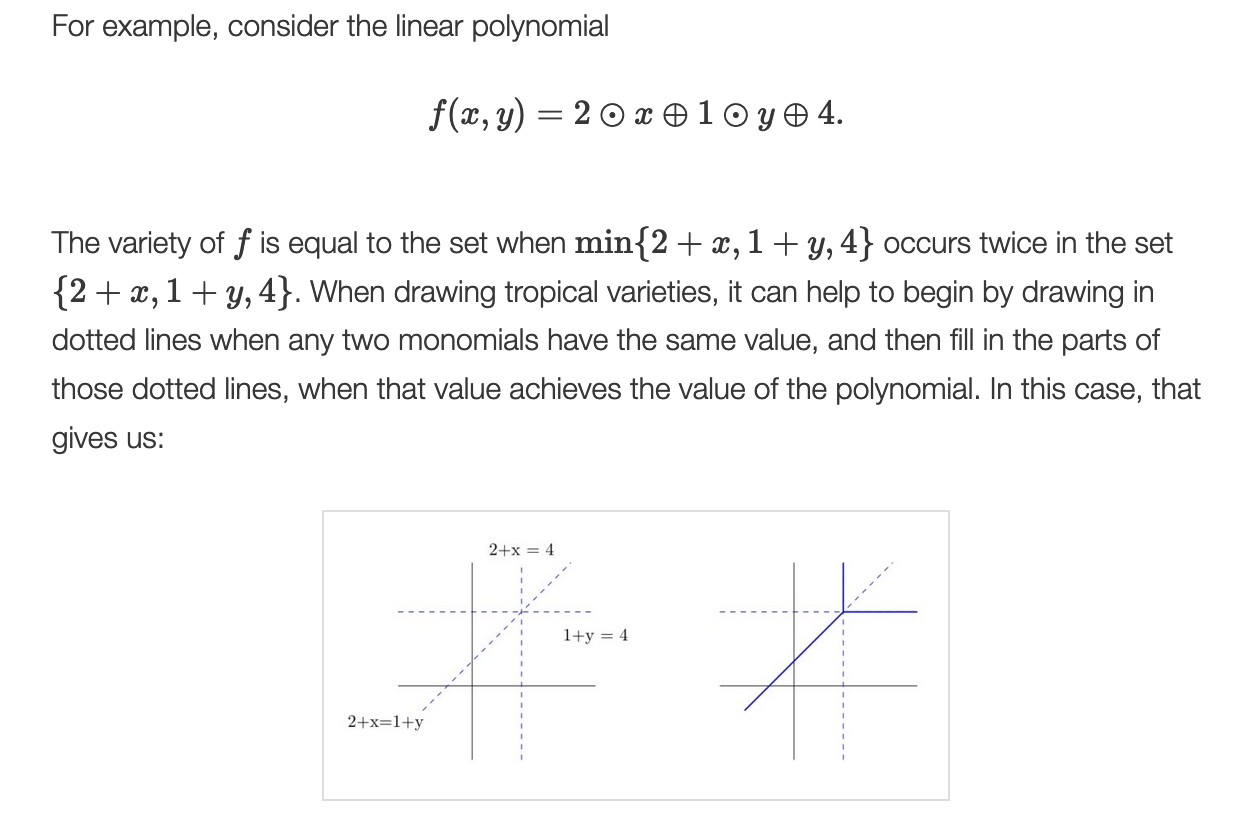
image from the matroid union post

Tropical variety of a linear tropical polynomial is called tropical hyperplane.

For any set AEA\subseteq E there is a natural representation of AA as a vector in {0,+}|E|\{0,+\infty\}^{|E|}, where the ii-th coordinate is 00 if iAi\in A and ++\infty otherwise.(This is very similar to the indicator vector of a set in {0,1}n\{0,1\}^n. If the ii-th element exists in the given set we put the identity element of \otimes and otherwise the identity element of \oplus.) Then we can define a linear tropical polynomial associated with a circuit cc just like the dot product of two vectors in n\mathbb{R}^n. For example consider a circuit c={1,2,3}c=\{1,2,3\} in U2,4U_{2,4}, fc(x1,x2,x3,x4)=(0x1)(0x2)(0x3)(+x4)f_{c}(x_1,x_2,x_3,x_4)=(0 \otimes x_1)\oplus(0 \otimes x_2)\oplus(0 \otimes x_3)\oplus(+\infty\otimes x_4).

Denote the tropical hyperplane of a circuit cc by T(c)T(c). T(c)T(c) is the space of all vectors vv where fc(v)f_c(v) achieves its minimum at least twice. T(𝒞)=c𝒞T(c)T(\mathcal C)=\bigcap_{c\in \mathcal C}T(c) is the set of vv excluded by all circuits in 𝒞\mathcal C. A set 𝒞𝒞(M)\mathcal{C}'\subseteq \mathcal C(M) is a tropical basis for matroid MM if T(𝒞)=T(𝒞)T(\mathcal C')=T(\mathcal C).

3 connections between the two definitions

Combinatorial definition. 𝒞𝒞\mathcal C'\subseteq \mathcal C is a tropical basis if for every non-flat set AA there is a circuit c𝒞c\in \mathcal C' that excludes AA.

Algebraic definition. 𝒞𝒞\mathcal C'\subseteq \mathcal C is a tropical basis if T(𝒞)=T(𝒞)T(\mathcal C')=T(\mathcal C).

Lemma For any 𝒞𝒞\mathcal C'\subseteq \mathcal C, T(𝒞)=T(𝒞)T(\mathcal C')= T(\mathcal C) if and only if T(𝒞){0,1}n=T(𝒞){0,1}nT(\mathcal C')\cap \{0,1\}^n= T(\mathcal C)\cap \{0,1\}^n

This lemma shows that we can only consider the indicator vectors when dealing with the algebraic definition.

Note that 𝒞\mathcal{C} excludes all non-flat sets of MM. Thus our combinatorial definition is equivalent to 𝒞\mathcal C' excluding the same sets as 𝒞\mathcal C. Let T¯(c)\overline{T}(c) be the collection of sets which are not excluded by CC. Then 𝒞\mathcal C' is a tropical basis if and only if T¯(𝒞)=T¯(𝒞)\overline{T}(\mathcal C')=\overline{T}(\mathcal C). Now we consider the algebraic definition. One can see that for any non-loop circuit cc and set AA, AT(c)A\notin T(c)(in other words, fc(A)f_c(A) achieves its minimum only once), if and only if cc excludes AA. Thus T(𝒞)T(\mathcal C) is the collection of all sets that are not excluded by any of the circuits in 𝒞\mathcal C. Now it is easy to see that these two definitions are equivalent.

current status It seems that Bergman fan of a matroid is related to this topic. https://arxiv.org/abs/math/0411260 This seems to be a bridge between matroid theory and algebraic geometry. June Huh’s work is also related to this topic. https://arxiv.org/abs/1104.2519